
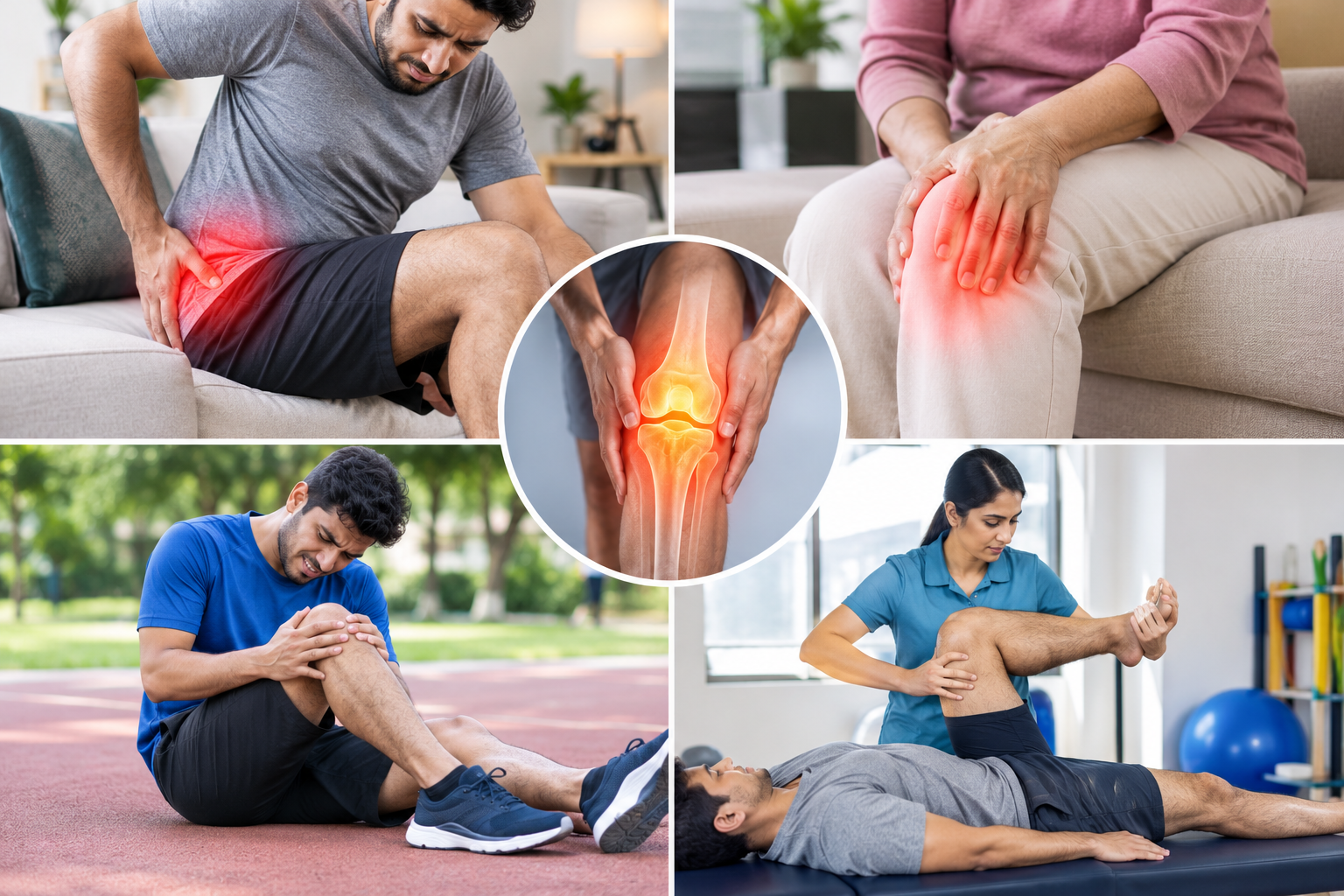
Chiropractic care in India gives you a non-surgical option for managing hip pain, knee osteoarthritis, chondromalacia patella, and sports injuries. Treatment usually combines joint adjustments, targeted rehab, and practical movement advice. Here’s what each condition involves — and what care actually looks like on the ground.
Most people don’t think about their hips or knees until something goes wrong. Then suddenly it’s all they can think about. Getting up from a chair becomes a calculation. Stairs become a problem. And the standard advice — rest, take something for the pain — doesn’t really explain why it’s happening or what to do about it long-term.
If you’re dealing with hip pain, knee osteoarthritis, chondromalacia patella, or a sports injury, this guide is for you. Chiropractic care isn’t a magic fix, but it does focus on the mechanical reasons behind pain — poor alignment, weak stabilizers, movement habits that quietly overload the wrong structures — and works on those directly rather than just managing symptoms.
Here’s what treatment can look like for each condition across India.
Hip Pain Treatment in India: What Are Your Options?
Hip pain comes from a lot of different places. It might be joint inflammation, a compressed nerve, a labral issue, or just years of loading the joint in a way it wasn’t designed for. Where the pain comes from shapes how it gets treated — which is why a thorough physical assessment matters before anyone puts a plan together.
A good chiropractor will look at how your hip moves, how your pelvis is sitting, and how your whole lower body functions when you walk. Hip pain treatment in India through chiropractic care may include:
- Spinal and pelvic adjustments — even a small pelvic tilt changes how load travels through the hip joint with every step. Getting that alignment right takes meaningful pressure off the joint over time.
- Soft tissue therapy — when the muscles around your hip are tight, your lower back and knee end up compensating. Releasing that tension helps the whole movement chain work the way it’s supposed to.
- Targeted strengthening — the glutes and hip stabilizers tend to switch off when you’ve been moving around pain for a while. Rebuilding them gives the joint actual support, not just symptom relief.
- Movement coaching — the way you sit, stand, and walk adds up over thousands of repetitions daily. Small corrections compounded over weeks make a real difference.
Hip pain treatment in India through this approach doesn’t involve surgery or long-term medication. It works with your body’s mechanics rather than around them.
Knee Osteoarthritis Treatment In India: Managing a Condition That Won’t Reverse Itself
Knee osteoarthritis tends to creep up on people. Cartilage wears down slowly, and at some point the joint starts making itself known — stiffness after sitting, swelling after a walk that wasn’t even that long, a grinding sensation on the stairs. By the time most patients come in, there’s already some structural change in the joint.
Cartilage doesn’t grow back. What chiropractic-based knee osteoarthritis treatment in India can do is reduce the mechanical load on what’s remaining — which matters for how you function day to day and how quickly things deteriorate. A structured plan may include:
- Joint mobilization focused on the tibiofemoral joint to improve how the knee bends and reduce that stubborn morning stiffness.
- Quadriceps and hamstring strengthening — weak muscles mean the joint takes on compressive forces it shouldn’t. Research suggests every kilogram of excess body weight adds roughly 4kg of force across the knee during normal walking, so building muscle around the joint is non-negotiable.
- Gait analysis to catch movement patterns accelerating wear — done observationally depending on the clinic.
- Weight management guidance, because the load math is pretty straightforward even when the lifestyle change is hard.
Getting into knee osteoarthritis treatment in India before Grade 3 or 4 cartilage loss gives you a much better shot at keeping real mobility over the long run.
Chondromalacia Patella Treatment In India: Getting the Kneecap to Track Properly
Chondromalacia patella happens when the cartilage under the kneecap softens and begins breaking down. Runners get it. Cyclists get it. Office workers who sit with knees bent for eight-hour stretches get it too. The pain usually sits right behind the kneecap — dull and achy, worse after stairs or standing up from a low seat.
Chondromalacia patella treatment in India through chiropractic care is mostly about fixing why the patella isn’t gliding properly in its groove. A typical plan includes:
- Patellar tracking correction — a combination of manual adjustment and taping techniques that encourage the kneecap to move centrally rather than grinding against one side.
- VMO strengthening — the vastus medialis oblique (inner quad) is almost always underactive in these cases. Getting it firing again changes where the kneecap sits during movement.
- Posterior chain flexibility — tight hamstrings change knee mechanics more than most people realize. This part of the plan isn’t optional if you want results that actually hold.
- Load modification — working out which specific movements to dial back temporarily while the tissue adapts, rather than just telling someone to stop exercising entirely.
Catching chondromalacia patella before it reaches full-thickness cartilage loss keeps your treatment options considerably wider.
Sports Injury Treatment In India: What Recovery Actually Looks Like
Not all sports injuries are the same. A Grade 1 ankle sprain, a hamstring strain, and a partial ACL tear each have different timelines, different loading requirements, and different markers for when it’s actually safe to go back to training. Chiropractic care fits alongside physiotherapy and sports medicine — particularly when alignment issues and soft tissue management are in play.
Sports injury treatment in India through chiropractic care can include:
- Soft tissue therapy in the early phase to manage inflammation and keep excessive scar tissue from forming the way it tends to when injuries are just rested without treatment.
- Joint adjustment once the acute phase settles — injuries frequently knock surrounding joints out of alignment, and those compensatory patterns become their own problem if nobody addresses them.
- Sport-specific rehab built around what your body needs to actually do in your activity, with clear return-to-play benchmarks rather than arbitrary timelines.
- Progressive movement assessments — typically at weeks 2, 4, and 8 — so loading gets adjusted based on how the tissue is genuinely responding, not just how you feel on a good day.
Minor soft tissue injuries can turn around in 3–6 weeks with the right structure. Ligament injuries generally need 8–16 weeks of proper rehab before full training is a reasonable conversation.
Your Next Step: Hip Pain, Knee Osteoarthritis & Sports Injury Treatment In India
One thing comes up consistently with these conditions: the longer you wait, the harder treatment gets. A hip issue caught early stays manageable. The same issue left for a year or two may end up needing surgery that a timely care plan could have prevented.
Chiropractic care isn’t the right answer for every clinical situation — and any honest practitioner will tell you that. But for musculoskeletal problems like these, it offers a non-surgical route that goes after the mechanical causes rather than just quieting the symptoms temporarily. Getting a proper assessment before the pain becomes disabling is, practically speaking, the best move most patients can make.
For more on what a care plan looks like and how to find a practitioner near you, visit the Chiropractor in India and connect with someone who can actually evaluate your situation.