
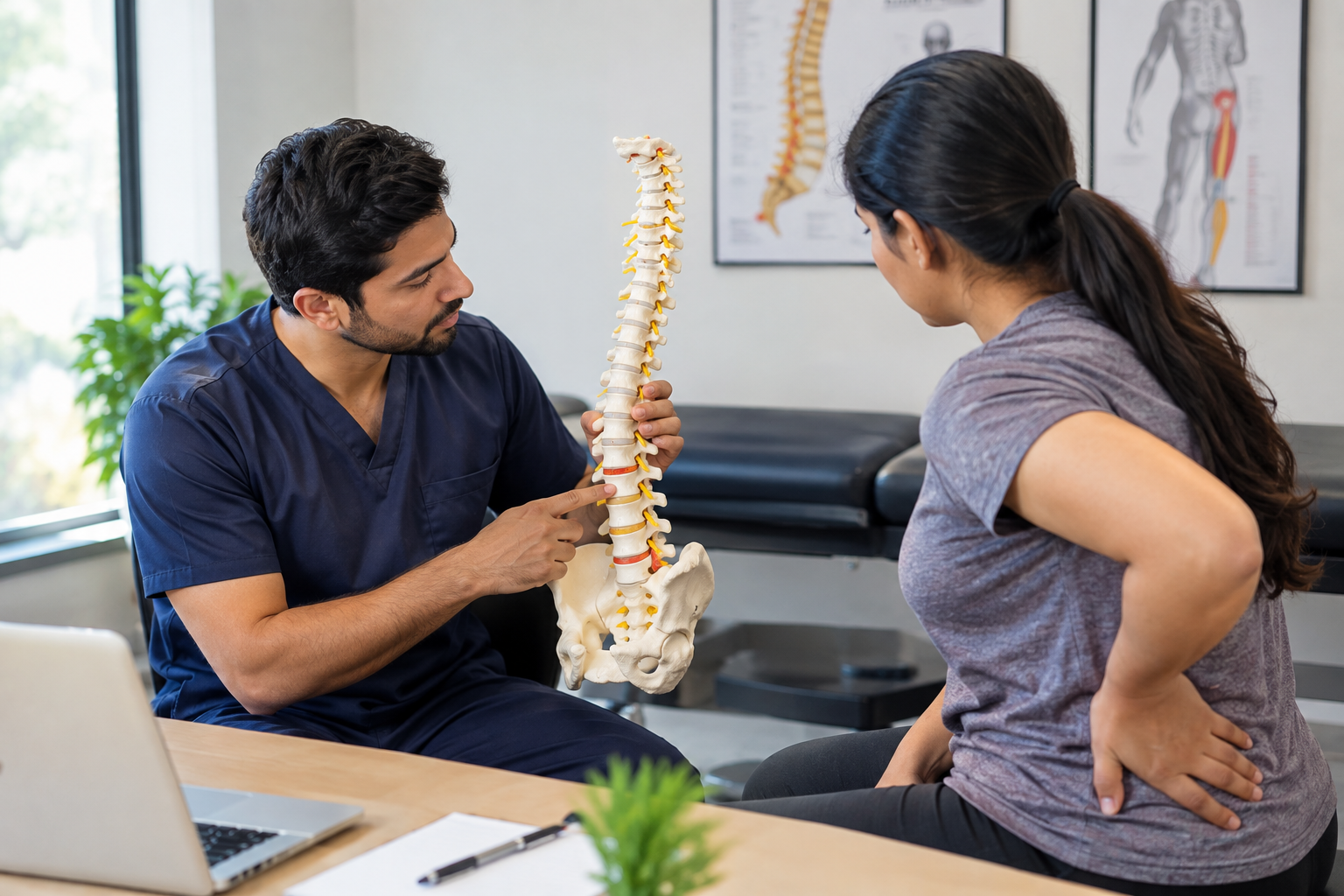
If you’re dealing with back pain, a disc bulge, disc herniation, or sciatica, India has solid treatment options available — from chiropractic care and physiotherapy through to surgery when it’s genuinely warranted. Where you start depends on your diagnosis, how long you’ve had symptoms, and how your body responds to initial care.
Here’s something we’ve seen repeatedly in spinal care: two patients with nearly identical MRI findings can end up on completely different treatment paths. One responds well to chiropractic adjustments and targeted exercise within a few weeks. The other needs an injection before they can even participate meaningfully in physiotherapy. Age, occupation, baseline fitness, and stress levels all shape how spinal conditions develop — and how they respond to treatment.
What follows is a practical, experience-grounded breakdown of four conditions that bring patients through spinal clinic doors across India every single day.
What Back Pain Treatment in India Actually Looks Like
Back pain is one of the most common reasons Indian adults visit outpatient clinics. And yet it’s also one of the most overtreated — too many people jump to imaging and pain medication before trying the basics.
A sensible back pain treatment approach in India usually starts here:
- Initial assessment — A thorough review of your symptoms, posture history, and past injuries. The point is to rule out anything serious before assuming it’s mechanical.
- Imaging (when genuinely indicated) — MRIs are useful for soft-tissue involvement; X-rays tell you more about bony alignment. Not everyone needs one on day one.
- Conservative treatment first — Physiotherapy, chiropractic adjustments, and anti-inflammatory medication cover most cases at this stage. Rest has a role, but complete inactivity tends to make things worse.
- Lifestyle changes alongside treatment — Posture correction, workstation adjustments, and a home exercise routine work best when they run in parallel with your clinical care — not as an afterthought.
- If nothing’s shifting after 6–8 weeks — That’s when injections or a surgical referral come into the picture. Not before.
Chiropractic care has become a legitimate first-line option in urban India. Patients appreciate that it addresses spinal mechanics directly rather than simply managing symptoms with medication.
Disc Bulge Treatment in India: Don’t Panic the Moment You See Your MRI
A disc bulge sounds alarming, but context matters. Many people walk around with a bulge on their MRI and have no symptoms whatsoever. Problems arise when that displaced disc starts pressing on a nearby nerve root — typically producing a predictable pattern of local pain, tingling, or weakness.
Disc Bulge Treatment in India generally follows this sequence:
- Physical therapy — Structured programs that strengthen the muscles supporting your spine and reduce load on the affected disc. Expect 8–12 weeks for meaningful, lasting improvement.
- Chiropractic adjustments — Spinal manipulation can restore movement to stiff segments and take some pressure off the irritated nerve.
- Pain management — NSAIDs like ibuprofen are the go-to for mild-to-moderate pain. Epidural steroid injections step in when nerve involvement is more significant.
- Identifying and cutting out the postures and movements that consistently aggravate your symptoms — prolonged sitting is a repeat offender for most desk workers.
- Surgery — Rarely needed for a disc bulge alone. It becomes a conversation when conservative treatment has genuinely been tried and progressive neurological symptoms aren’t responding.
If symptoms are recent and manageable, conservative care is the right starting point. Numbness or weakness spreading toward the foot deserves faster specialist attention.
Disc Herniation Treatment in India: A Staged Approach That Works
A disc herniation is a step beyond a bulge. The disc’s inner material breaks through its outer wall and can press directly on a nerve root — sometimes the spinal cord, in more serious cases. Pain is typically sharper and more radicular, meaning it follows the nerve pathway into the leg or arm rather than sitting locally.
Disc Herniation Treatment in India tends to move through stages:
- Getting the diagnosis right — A lumbar MRI at the relevant level confirms the herniation’s location and which nerve roots are involved. Don’t commit to a treatment plan without this.
- Non-surgical management — Physiotherapy, chiropractic care, and oral medication remain the starting point even for confirmed herniations. Most patients improve here.
- Epidural steroid injections — Administered under fluoroscopic guidance, these reduce nerve inflammation and can provide weeks to months of relief while the disc heals on its own.
- Microdiscectomy — A minimally invasive procedure to remove the herniated fragment. Typically considered after 6–12 weeks of failed conservative management with ongoing neurological symptoms.
- Open surgery — For complex presentations: significant canal compromise, multiple levels, or loss of bladder or bowel control. These cases can’t wait.
Around 90% of people with a disc herniation get better without surgery — usually within 6–12 weeks of consistent conservative care. Surgery enters the conversation when that window closes without meaningful improvement, or when deficits like muscle weakness or reflex changes are actively worsening.
Sciatica Treatment in India: It’s About the Source, Not Just the Leg Pain
Sciatica is a symptom. When pain radiates from the lower back through the buttock and down the leg, something is irritating the sciatic nerve — and the job of a proper assessment is to figure out what. A disc bulge or disc herniation at L4-L5 or L5-S1 is responsible for the majority of cases.
Sciatica Treatment in India usually follows this path:
- Finding the root cause — A lumbar MRI is almost always the key diagnostic step. Piriformis syndrome and lumbar canal stenosis account for a smaller share of cases.
- Conservative care as the foundation — Structured physiotherapy, chiropractic adjustments targeting the lumbar spine, and neural flossing exercises are standard starting points.
- Medication when needed — Pregabalin or gabapentin for the nerve pain component; NSAIDs for inflammation. These work better as a bridge to active treatment than as a standalone solution.
- Simple measures that actually help — Ice in the first 48–72 hours of an acute flare, heat for ongoing muscle tightness. It’s easy to overlook these when you’re chasing more advanced options.
- Injections or surgery — When sciatica persists past 12 weeks or is severe enough to stop someone from functioning day-to-day, these become appropriate next steps.
Think of sciatica like a fault partway along an electrical cable. The disruption shows up along the whole line, but the problem itself is at one specific point. Treating the leg pain directly rarely resolves anything. The lumbar spine is where the real work happens.
Taking the First Step Toward Better Back Pain Treatment in India
Across all four conditions, earlier intervention tends to produce better outcomes. Patients who start physiotherapy or chiropractic care within the first 4–6 weeks of symptoms recover faster and are far less likely to end up needing surgery.
If you’re not sure where to start, a chiropractor is a practical first contact — the focus is on identifying what’s structurally driving your pain rather than masking it. To find chiropractic care near you, visit the Chiropractor in India website and explore what a proper assessment and care plan might look like for your situation.