
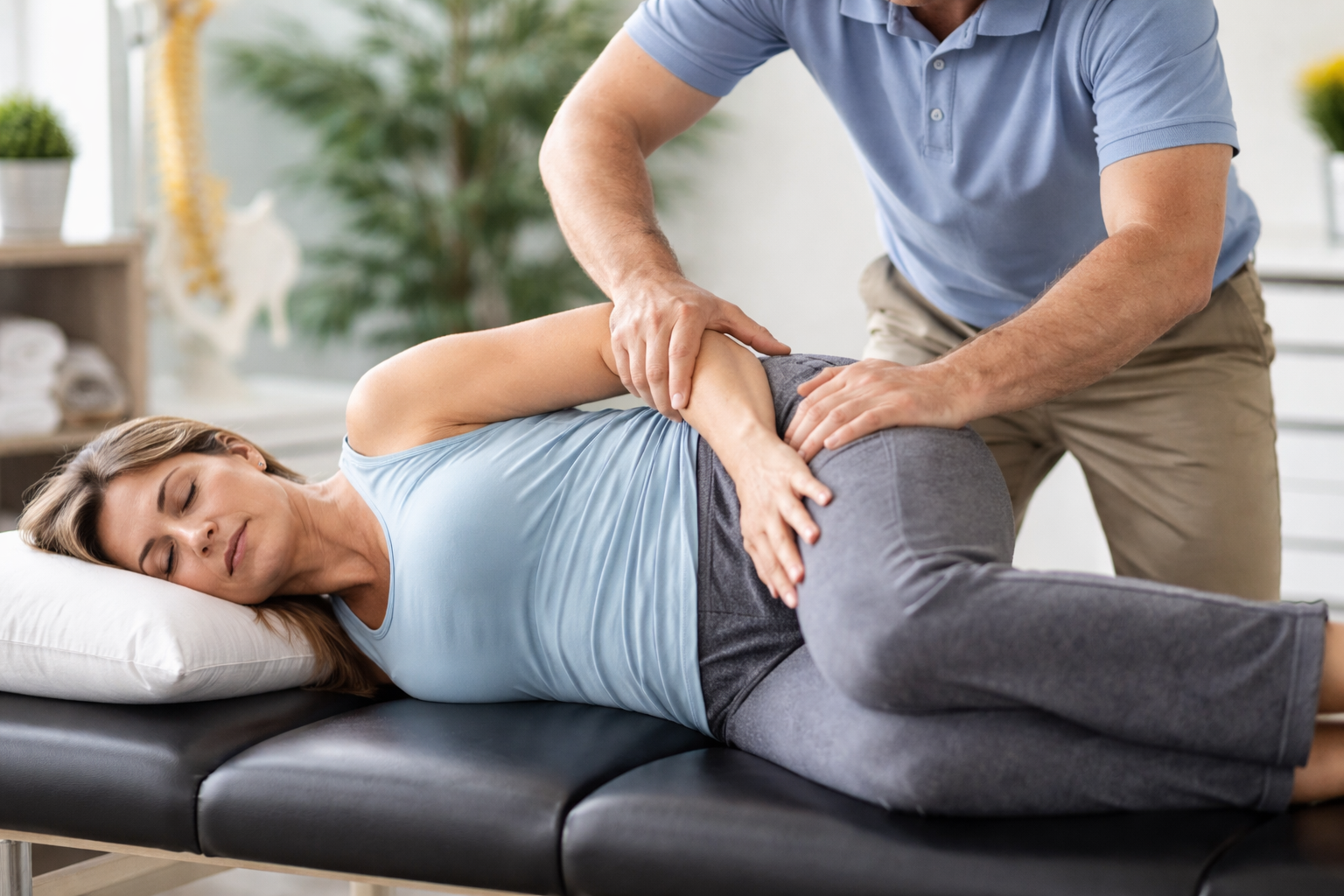
Hip pain in India most often comes down to joint degeneration, muscle imbalance, or the cumulative load of floor-based habits that most ergonomic guidelines don’t account for. Knee pain, separately, tends to point toward osteoarthritis or chondromalacia patella. Hip pain treatment in India typically starts with physiotherapy or chiropractic care before anything more invasive. Knee osteoarthritis treatment in India focuses on reducing joint load and rebuilding supporting muscle. If pain has been with you longer than two weeks, or is waking you at night, don’t put off getting it looked at.
Somewhere between 15 and 25% of adults in India deal with chronic hip or knee pain — and urban centers are seeing the sharpest rise. Long commutes, desk jobs that keep people seated for eight or more hours, and cultural habits like prolonged floor-sitting all load these joints in ways that add up quietly over years. By the time most patients walk into a clinic, the problem has been building for months.
This article covers what’s actually driving hip and knee pain in Indian patients, what treatment options exist, and when conservative care isn’t enough. We’ll spend particular time on two knee conditions that show up repeatedly in practice: osteoarthritis and chondromalacia patella.
What Causes Hip Pain in India?
Hip pain in India doesn’t follow the same patterns you’d see in a Western clinical population, mostly because of how the hip joint gets used day to day. Squatting over a stove, sitting cross-legged through long family meals or prayer, and climbing several flights of stairs in older buildings — these aren’t occasional stresses. For many patients, they’re daily habits spread across decades.
Key contributors include:
- Osteoarthritis: Cartilage gradually wears away inside the hip joint. Patients over 50 who mention stiffness lasting more than 30 minutes after waking are frequently showing early-stage OA — something an X-ray confirming joint space narrowing usually backs up.
- Muscle imbalance — particularly a weakened gluteus medius alongside chronically tight hip flexors — is extremely common in office workers and drivers. It doesn’t hurt acutely; it loads the joint capsule in a way that slowly becomes painful over months.
- Trochanteric bursitis: Inflammation of the fluid sacs on the outer hip. This one gets misdiagnosed as referred lumbar pain often enough that it’s worth keeping in mind when a patient describes lateral hip aching that worsens with side-sleeping.
- Postural strain from poor desk setup. Eight hours a day with a tucked pelvis and rounded spine places sustained compression on the anterior hip capsule. It’s not dramatic — it’s just constant.
- Old, inadequately rehabilitated injuries. A hip strain from a road accident that “cleared up” after two weeks of rest but was never properly assessed can quietly drive symptoms years later.
Left alone, these problems progressively limit walking distance, disrupt sleep, and make basic tasks — getting up from the floor, climbing into an auto — genuinely difficult.
What Are the Hip Pain Treatment in India Options?
Most patients do well with conservative care, and that’s where hip pain treatment in India should start. Moving too quickly toward injections or surgery — without putting in the work on structured rehabilitation first — is a clinical misstep that happens more often than it should.
Physiotherapy addresses the root mechanical issue. A good program targets gluteal activation, hip flexor lengthening, and progressive load tolerance. Patients who stick with a 6–8 week structured protocol typically report 40–60% reductions in pain on the Visual Analog Scale. Generic stretching, done inconsistently, doesn’t get those numbers.
Chiropractic care looks at hip pain through the lens of joint alignment and soft tissue restriction. When sacroiliac joint dysfunction or lumbar segments are contributing to hip symptoms — which happens more frequently than imaging alone reveals — spinal adjustment combined with hip mobilization can reach pain that physiotherapy alone doesn’t fully resolve.
Corticosteroid injections have a place in managing acute inflammatory flares, especially bursitis. Used once or twice, they give rehabilitation time to work. Beyond three injections in a 12-month period, the cartilage degradation risk starts to outweigh the relief.
Hip replacement is reserved for patients with severe structural damage, avascular necrosis, or end-stage osteoarthritis that hasn’t responded to 3–6 months of honest conservative effort.
If you’re eight weeks into consistent treatment with little to show for it, that’s the signal to investigate further — not to push through another eight weeks of the same approach.
How Is Knee Osteoarthritis Treated in India?
Knee osteoarthritis treatment in India has become considerably more evidence-based over the past decade. Cartilage doesn’t grow back, but the right approach can meaningfully reduce pain and preserve function for years before surgical options become relevant.
A stepped approach reflects current evidence:
- Weight reduction: Each kilogram lost reduces knee joint load by roughly four kilograms per step. A patient dropping from 85 to 75 kg is removing 40 kg of force from that joint with every stride they take.
- Low-impact conditioning: Stationary cycling and pool physiotherapy build quadriceps and hamstring strength without compressing damaged cartilage. Jogging shouldn’t be part of the plan for anyone with grade II or higher cartilage loss.
- Chiropractic adjustment: Pelvic or spinal misalignment often places asymmetric load on one knee over the other. Postural analysis and gait assessment can identify this — and correcting it reduces wear on the more heavily loaded compartment.
- Bracing: An unloader brace redistributes force away from the affected medial or lateral compartment. For patients with unicompartmental OA, it’s one of the most underused tools in Indian clinical practice.
- Viscosupplementation: Hyaluronic acid injections — Synvisc and Durolane are both available in India — can deliver 6–12 months of meaningful pain relief in moderate cases. Patient selection matters; this works better at grade II–III than in bone-on-bone grade IV.
A patient who hasn’t completed a supervised 12-week exercise program isn’t a surgical candidate yet. Document what’s been tried before escalating.
How Is Chondromalacia Patella Treated in India?
Chondromalacia patella treatment in India gets delayed far too often because the condition gets lumped in with general knee pain. It’s specific: the cartilage on the underside of the kneecap softens and breaks down, typically because of patellar malalignment as it tracks along the femoral groove.
Runners, cyclists, and IT professionals who sit with knees bent past 90 degrees for hours are the most frequent presenters. Pain usually shows up as a dull ache behind the kneecap — worse on stairs, after prolonged sitting, or when squatting. All three of those are unavoidable in daily Indian life, which is why the condition tends to persist when it isn’t addressed properly.
Treatment priorities:
- Activity modification: Cutting out stair climbing and deep squatting for 4–6 weeks isn’t optional — it’s what gives inflamed cartilage the chance to settle. Patients who train through it typically extend their recovery by months.
- Vastus medialis oblique (VMO) strengthening through terminal knee extensions and step-downs. This specific muscle controls medial patellar tracking, and weakness here is the most common biomechanical driver of the condition.
- McConnell patellar taping, applied by a trained physiotherapist, can shift patellar alignment during activity and reduce pain by 30–50% within sessions — sometimes immediately.
- Chiropractic assessment of foot pronation and hip rotation is worth adding when standard physiotherapy stalls. Both affect patellar tracking from above and below, and missing them is a common reason treatment plateaus.
- Ice for 15 minutes after activity. It manages flares without medication and costs nothing.
Chondromalacia patella treatment in India works best at grade I or II. Grade III and IV cases often need arthroscopic intervention, which is available at major orthopedic centers in Chennai, Hyderabad, and Pune.
When Should You See a Chiropractor in India?
Pain that hasn’t improved after two to three weeks — or that keeps coming back after a few days of rest — deserves a chiropractic evaluation. Chiropractors are trained to find joint misalignment, postural dysfunction, and soft tissue imbalances that standard imaging misses, because those problems don’t show up on X-ray or MRI.
Hip and knee pain connected to lower back or pelvic issues responds especially well to chiropractic care. A patient presenting with right knee pain that originates from left sacroiliac joint dysfunction, for instance, won’t improve with knee-focused physiotherapy alone. The upstream problem has to be addressed.
A chiropractor in India working alongside a physiotherapist gives patients both things at once: joint alignment and progressive rehabilitation. The timing matters, too. A misaligned joint left unaddressed for six months develops compensatory muscle patterns that take considerably longer to unwind than the original problem would have.